There’s no single best stain remover for clothes. There’s a best one for a certain kind of buyer, with a certain kind of stain and a certain kind of routine. Most people who buy one are choosing between a few things: how fast they need to act, whether they want a spray for the wash or a pen for the bag, and whether the stain is fresh food or something that has already dried in. These products differ on exactly those points, and it helps to know which difference matters to you before you compare features.
Start with timing. A stain that has just landed on your shirt is a different problem from one you found this morning on a garment that has been in the hamper for two days. The listings for the pens stress treating a spill right away, before it sets. That’s a real advantage when you’re out and can’t get home to a washer. But if you’re sorting a full load at home, the bigger question is whether you can pre-treat before washing at all.
Next, think about where you’ll be when the stain happens. A product that lives in your bag only helps if you carry it. Several of these are built for that: the Tide To Go Pen is described as small enough to fit in any bag or pocket, and the Pen Pro is pitched for travel and everyday use with no mess and nothing to throw away. A spray bottle does more per treatment and suits a home routine, where you can spray, wait, and wash. Neither is better in general. The spray is for the laundry room. The pen is for the moment.
Finally, consider the stain itself. Fresh food and drink spills are what the pens are designed around, and their listings name coffee, wine, ketchup, and similar spills. Stains that have dried or set, such as mud, grass, and grease, are where the sprays and the boar-bristle brush are described as doing more. The brush works a treatment into the fibers, which matters on fabrics where a stiff brush would fuzz or pill the surface. It isn’t suitable for silk or wool, so check the garment label before you reach for it.
If you’re still unsure, ask yourself which of these you’ll actually do in a typical week: treat a spill the moment it happens, or run a pre-treatment before the wash. Your honest answer tells you more about the right fit than a feature list does.
Quick Navigation
Comparison Table
| # | Product | Best for | |
|---|---|---|---|
| 1 | Triple-Acting Active Enzyme Spray | Top Pick | Check Price |
| 2 | Tide To Go Pen | Runner-Up | Check Price |
| 3 | Max Force Laundry Stain Treater | Also Great | Check Price |
| 4 | Pen Pro Stain Remover Stick | Best for No-Bottle Use | Check Price |
| 5 | Laundry Stain Brush Boar Bristles | Best for Hand Treating | Check Price |
Pick By Your Situation
Start with where the stain is and how often you’ll be treating it. If you’re mostly dealing with spills while you’re out, a pen is the practical choice: the Tide To Go Pen and the Pen Pro both fit in a bag or pocket, and the Pen Pro needs no separate cloth or bottle. The Tide To Go Pen’s steps are to blot up any excess, press the tip onto the stain, and rub it with the microfiber pad, repeating if the stain is stubborn.
The Max Force Stain Treater makes the same claim, which suits a household with a lot of laundry on non-wash days.
For small, stubborn marks on fabrics you don’t want to damage, the boar bristle brush is the tool to add. You’ll still need a spot remover to use with it, so it works as a companion to one of the products above, not a replacement.
1. Triple-Acting Active Enzyme Spray

Best for: Someone who pre-treats a full laundry load most weeks.
A spray that works before the wash has a different job than a pen. You need enough product to cover a stain and time for it to soak in. This spray is built for that. The listing says it works on a wide range of stains, from food and drink to grass, dirt and red wine. It also says it works in all water temperatures and in both HE and standard washers, so you don’t need to change how you wash.
The listing also says you can spray a stain and wash it up to a week later. That helps if you don’t do laundry every day. The bottle is 22 ounces and is made with 25% post-consumer recycled plastic, which the listing mentions directly.
Good if: You want one spray that covers food, drink and outdoor stains. You wash in a standard or HE machine. You want something you can use on whites and colored fabrics alike.
Skip it if: You need something that fits in a bag. You only have one or two stains a month.
2. Tide To Go Pen

Best for: Someone who gets spills away from home.
A pen is for the moment the stain happens, before you can get to a washer. Repeat if the stain is stubborn.
The listing names a long list of food and drink stains it handles, including tomato juice, ketchup, BBQ sauce, grape juice, coffee, wine, tea and chocolate syrup. It’s small enough to fit easily in a pocket or a work bag, so it’s there when you need it. Blotting first is the step that gets the most out of the pen, because it removes the loose spill before the solution goes on.
Good if: You want to act on a spill at work, at a restaurant or while running errands. You want something bleach-free for colored clothes.
Skip it if: You’re treating a whole shirt or a stain that has been sitting for days.
3. Max Force Laundry Stain Treater
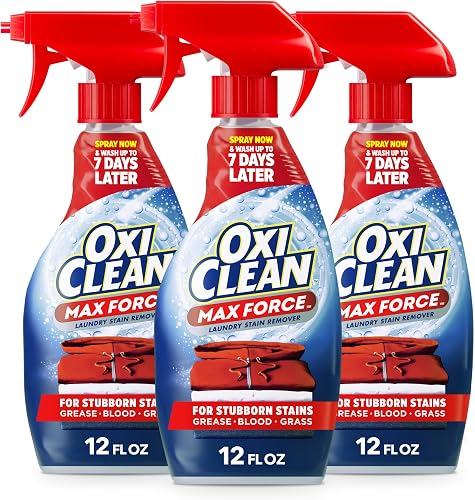
Best for: A household with babies or young kids and a lot of laundry.
Baby clothes take a lot of stains, and this spray is aimed at them. The listing names baby food, fruit juice, grass, mud, oil, grease, ink and washable paint among the stains it handles. It says it contains no chlorine bleach, no brighteners, no dyes and no phosphates, which matters if you want fewer harsh ingredients near a baby’s skin.
The listing says you can spray now and wash up to seven days later, which fits a busy week. That gap is useful when a spill happens during the day and the load doesn’t go in until the weekend.
It’s listed for a wide range of machine-washable fabrics, from onesies and bibs to towels, denim and workout gear. The listing also names cotton, linen, spandex, fleece, polyester and nylon. The listing describes it as a color-safe enzymatic stain remover for all machine-washable fabrics.
Good if: You do a lot of laundry for little ones. You want a color-safe spray without bleach or dyes.
Skip it if: You want something for on-the-go spills rather than a bottle that lives by the washer.
4. Pen Pro Stain Remover Stick

Best for: Someone who wants a stick with no bottle to manage.
This is a stick, not a spray, and the listing stresses that it’s mess-free. There’s nothing to throw away and nothing to get on your hands. That matters most when you’re reaching for a stain remover in a hurry, away from home, with no sink or washing machine nearby. You uncap it, press, and rub, without pouring anything or handling a wet cloth.
It’s aimed at fresh food and drink stains that haven’t yet set. The product name points to the same idea: get to the stain before it sets in. So the time between spill and treatment is the main thing you control.
The usage steps are clear: remove excess residue, press the tip onto the stain to release the solution, rub gently across the stain, and repeat if needed. Two details help in practice. Removing the excess first means you’re working on the stain itself, not on what is sitting on top of it. And the instruction to rub gently, rather than hard, is worth following, since the listing doesn’t suggest any scrubbing is needed.
The limit is in its design. It’s made for fresh stains. Older, dried-in marks are a different job, and this listing doesn’t claim to handle them. If you find yourself repeating the steps many times on a mark that isn’t lifting, that’s a sign the stain has likely set and needs a different approach than a fresh-stain stick.
Good if: You want a neat stick for fresh food and drink stains. You don’t want a liquid bottle in your bag.
Skip it if: Your main problem is old or set-in stains.
5. Laundry Stain Brush Boar Bristles

Best for: Someone who works a spot treatment into delicate fabric by hand.
This is a tool, not a product. It’s meant to be used with a spot remover, not on its own. The brush works the remover into the fibers so it can do its job, which is why the listing pairs it with a spot treatment rather than presenting it as a stain remover itself. The soft boar bristles are described as gentle on knits, cotton and linens, and the listing says they won’t pill fabric the way a stiff toothbrush might. That matters most on garments you would otherwise hesitate to scrub at all.
The handle has a curved, ergonomic grip that the listing says gives you more force for scrubbing. The handle’s curved grip adds force, so the soft bristles are what keep the fabric safe while you scrub.
It measures 6.3 by 0.79 by 1.26 inches, with bristles 0.6 inches long, so it’s small and easy to store. The listing says it isn’t suitable for silk or wool, and that rule should be treated as a limit on where you use it. Keep the handle dry and let the brush air-dry, as the listing advises. The hanging loop on the end of the handle is there for that purpose.
Good if: You want a gentle scrubbing tool for knits and linens. You already use a spot remover and want something to work it in.
Skip it if: You want a product that works without a second step. You mostly wash silk or wool, which the listing rules out.
Where These Overlap
The Triple-Acting Active Enzyme Spray and the Max Force Laundry Stain Treater are close. Both are sprays for pre-treating laundry and both list a wide range of stains. The choice between them comes down to whether you want a bleach-free, dye-free option for baby clothes, which points to the Max Force, or a broader all-purpose spray, which points to the Triple-Acting.
The Triple-Acting listing doesn’t describe its formula in those terms, but it does say it works on machine-washable whites and colored fabrics. If your main concern is a newborn’s clothes, that difference matters more than the list of stains.
The Triple-Acting also has a practical feature worth weighing: its listing says the formula lets you treat tough stains and wash up to a week later.
The Tide To Go Pen and the Pen Pro Stain Remover Stick are also close. Both are small, both are for fresh spills, and both are meant for travel. The pen’s listing mentions a microfiber pad for rubbing the stain, while the Pen Pro is described as mess-free, with nothing to throw away and nothing to get on your hands. That detail is what would separate them for you.
The pen’s three steps are to blot up excess residue, press the tip to release the solution, and rub gently with the pad, repeating if needed. The Pen Pro’s steps are similar, but its listing stresses that you never touch the solution, so if you dislike handling a wet stain remover, the Pen Pro is the better fit.
The Laundry Stain Brush is different from the rest. It’s a tool, so it doesn’t compete directly with a spray or a pen. It makes sense only alongside one of the sprays or pens, not as a substitute for them.
Still Not Sure?
How often will I really use it?
If you do laundry most days, a spray that sits by the washer will get used. If you only deal with the occasional spill, a pen in your bag is enough. The Triple-Acting Active Enzyme Spray suits frequent use, while the Tide To Go Pen suits the one-off spill. Think about how often a stain actually happens to you before you choose.
What do I already own that this has to work with?
Check your washer and the fabrics you wear most. The Triple-Acting Active Enzyme Spray says it works in HE and standard washers and on whites and colors alike. The Max Force suits families with baby clothes. If you already use a spot remover, the Laundry Stain Brush can add to it, but it doesn’t replace one.
What am I most likely to regret choosing?
Most people regret buying something that doesn’t fit the stain they actually get. A pen won’t handle a whole shirt, and a spray is awkward at a restaurant table. Match the product to the stain you deal with most, not the one you imagine.
Frequently Asked Questions
Can I use a stain remover spray on delicate fabrics?
Some can. The Laundry Stain Brush is listed as suitable for delicate fabrics like knits and linens, though not silk or wool. The Max Force is described as color-safe and free of bleach and dyes. Always check the care label of the garment first, and test a hidden spot before treating a visible stain.
Do I need to wash right away after treating a stain?
Not always. The Triple-Acting Active Enzyme Spray and the Max Force Laundry Stain Treater both say you can treat a stain now and wash up to a week later. That’s useful if you don’t do laundry daily. Fresh stains are easier to lift, though, so treating early still helps.
Is a stain pen as effective as a spray?
It depends on the stain. The Tide To Go Pen and the Pen Pro are built for small, fresh spots you can reach right away. A larger or older stain usually needs the more concentrated spray and time to work before the wash.
Which product works with a washing machine?
The Triple-Acting Active Enzyme Spray says it works in HE and standard washers. The Max Force is listed for machine-washable fabrics. The pens and the stick are used before washing, so they fit any machine.
Conclusion
Before you buy, take one stained shirt and test the product on a hidden seam first, then wait a few minutes to see whether the fabric changes color. Keep the bottle near your laundry, not in a drawer, so you can act while the stain is still fresh. If the first choice doesn’t work, you’ll know quickly, and you can try a different type on the next spill.